
Strong, Capable… and Quietly Exhausted: What Women Carry...
January 12, 2026
Full Title: Strong, Capable… and Quietly Exhausted: What Women Carry in Silence
A gentle reminder for the women who carry everything and everyone
Written By: LaTreece Ross, M.Ed., LPC

Women often carry a constellation of roles—mother, partner, professional, caregiver, friend, mentor, problem-solver, emotional anchor, and sometimes the unofficial therapist for everyone around them. These roles overlap, expand, and shift depending on life’s demands, often without warning. Clinically, this combination of role multiplicity and emotional labor places women at higher risk for chronic stress, compassion fatigue, and burnout. When a woman is expected to “do it all,” she often does—but the cost is usually paid with her own rest, energy, or emotional capacity. The pressure to perform flawlessly in every role, often without adequate support or personal time, creates an environment where stress accumulates faster than it can be processed.
In therapy, many women describe feeling like they are “always on,” responsible for maintaining the emotional climate of their home, meeting expectations at work, supporting extended family, and keeping up with social and community roles. Over time, your body can get stuck in a prolonged stress response—fight, flight, or survival mode—making self-care feel like another task instead of a source of relief. Caring for everyone else becomes second nature, while caring for oneself becomes optional or even guilt-inducing. Society reinforces this cycle by equating a woman’s worth with productivity and selflessness, leaving her feeling ashamed or “selfish” for needing rest, slowness, or boundaries.
As burnout develops, the signs are often subtle at first. Clinically, we see emotional exhaustion, irritability, increased anxiety, or a sense of detachment from activities that once brought joy. Women may notice difficulty concentrating, forgetfulness, disrupted sleep, or physical symptoms such as headaches, muscle tension, digestive issues, or frequent illnesses. Emotionally, many report feeling overwhelmed by small tasks, withdrawing from loved ones, or experiencing a quiet resentment—even toward people they genuinely care for. Sometimes burnout looks like shutting down emotionally; other times it looks like tears that arrive without warning.
When burnout is already present, symptoms become more pronounced: chronic fatigue, emotional numbness, decreased motivation, increased sensitivity to stress, or the sense of running on autopilot. You may catch yourself thinking, “I’m tired, but I can’t stop,” or “Everyone needs me, but I’m disappearing.” These are not signs of weakness—they are indicators of depletion. Recognizing them early is essential, because healing begins with awareness, boundaries, rest, and the permission to prioritize your own well-being—not as an afterthought, but as a non-negotiable part of your life.
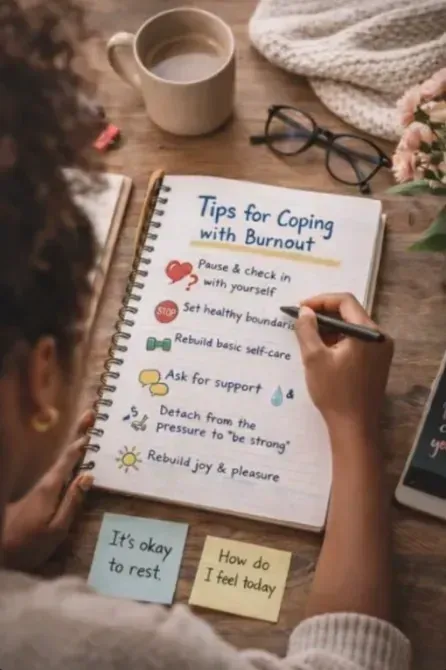
7 Gentle Truths for Women Who Carry It All
- Strength Includes Rest
- Resilience without rest leads to burnout. Rest is part of health—not a reward.
- Emotional Exhaustion Is Real
- Fatigue can show up as irritability, numbness, or feeling “off”—even when life looks stable.
- You Don’t Have to Do Everything Alone
- Allowing support is a sign of sustainability, not weakness.
- Boundaries Are Protective, Not Punitive
- Saying no helps preserve your energy and emotional capacity.
- Your Needs Matter Too
- You are more than the roles you fill. Your needs deserve attention.
- Making Rest Non-Negotiable
- Small, consistent pauses matter more than waiting for the “perfect time” to rest.
- Therapy Can Be Your Soft Place
- A space where you don’t have to be strong, composed, or in control—just honest.
Take a Quiet Moment to Reflect
- In what ways am I strong—but exhausted?
- Where have I been prioritizing responsibility over well-being?
- Right now, what I need most for my well-being is….......
A Note for Your Heart
You don’t have to be falling apart to deserve support. Awareness is the first step toward balance. Being strong doesn’t mean doing everything alone. Support can help you carry life with more clarity, compassion, and ease. If this resonates, therapy can help you reconnect with yourself, return your body to a place of calm, and learn to hold your strength without carrying the weight alone.