When Self-Love Feels Unfamiliar: Learning to Pour Into Yourself..
February 2, 2026
Full Title: When Self-Love Feels Unfamiliar: Learning to Pour Into Yourself First
Written By: LaTreece Ross, M.Ed., LPC

For many people, the idea of self-love sounds beautiful in theory—but complicated in practice.
We were taught early on that love looks like doing:
Doing for family.
Showing up for friends.
Sacrificing for work.
Holding everything together.
In many homes, love was modeled as service, responsibility, and endurance—not rest, boundaries, or emotional attunement. So when the conversation shifts to loving yourself, it can feel selfish, indulgent, or simply unfamiliar. If no one showed you what healthy self-love looked like, it makes sense that practicing it now feels awkward—or even wrong.
When Love Is Learned Through Over-giving
Many adults grow up believing that their value is tied to how useful, productive, or available they are to others. Love becomes conditional: I am loved when I help, fix, provide, or perform.
Over time, this conditioning creates an internal belief system that says:
- My needs come last
- Rest must be earned
- Saying “no” means letting people down
- Slowing down equals failure
And so, self-love feels uncomfortable—not because it’s wrong, but because it challenges everything you were taught about worth and responsibility.
The Mirror Moment: When You Don’t Recognize Yourself Anymore
There often comes a moment—quiet or loud—when you look in the mirror and realize you don’t recognize the person staring back at you.
Maybe you’re exhausted.
Maybe you feel disconnected.
Maybe you’ve been operating on autopilot for years.
Work demands.
Family obligations.
Caregiving roles.
Survival mode.
None of these are failures. They are understandable responses to life’s pressures. But over time, prioritizing everything except yourself creates emotional distance from who you are and what you need.
Self-love isn’t about vanity—it’s about reconnection.
Why Filling Your Cup First Changes Everything
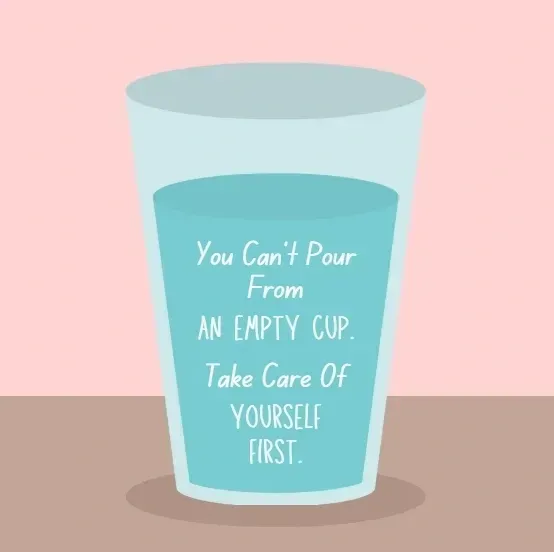
Contrary to what many of us were taught, loving yourself does not take away from others—it multiplies what you’re able to give.
When your cup is filled:
- You show up more present and patient with family and friends
- You’re more focused and productive at work
- You’re better able to pursue goals without burning out
- You respond instead of react
- You set boundaries without guilt
Self-love allows you to understand your capacity, not push past it. It teaches you when to pause, when to say no, and when rest is not optional—but necessary.
You don’t pour from an empty cup.
And you don’t serve others well when you’re depleted.
Self-Love Is a Skill—Not a Personality Trait
For many people, self-love feels foreign simply because it was never modeled. If you didn’t see your parents rest, speak kindly to themselves, or prioritize their emotional well-being, then self-love wasn’t part of your emotional language growing up.
That doesn’t mean you can’t learn it now.
Self-love is not a switch—it’s a practice.
It’s built through small, consistent choices:
- Listening to your body instead of ignoring it
- Honoring your emotional limits
- Creating space for rest without guilt
- Speaking to yourself with compassion, not criticism
Over time, unfamiliar becomes intentional.
Intentional becomes natural.
Natural becomes sustaining.
Choosing Yourself Is Not Abandoning Others
One of the hardest truths to accept is this: choosing yourself does not mean you care less about others—it means you care enough to show up whole.
Self-love isn’t about pulling away from the world.
It’s about returning to it grounded, regulated, and emotionally available.
When you learn to love yourself, you don’t lose your ability to love others—you strengthen it.
And maybe that’s the real invitation of self-love:
Not to become someone new—but to finally come back to yourself.