
Curious about trauma-informed therapy in Plano but unsure what to expect? Walk through the real client journey — intake to ongoing sessions — before you commit.

There are seasons in life when everything flows with rhythm , and then there are seasons like this one. It often begins quietly. A stressful situation at work, a shift in your health, a financial strain, or a relationship challenge. You manage it, telling yourself, “I’ll get through this.” But before you can fully recover, another challenge follows. Then another. Soon, the space between difficulties disappears. You find yourself waking up tired—not just physically, but emotionally. Your thoughts begin racing: “Why does it feel like it’s always something?” “Why can’t I catch a break?” This is the ripple effect of life—when challenges stack faster than your ability to process them. The Impact Beneath the Surface Over time, the weight of repeated stress can begin to shift how you see yourself. You may start to question your abilities or internalize circumstances that were never your fault. Thoughts like “Maybe I’m not enough” can quietly replace “This is just a hard season.” At home, the strain may show up in shorter conversations, irritability, or withdrawal. Not from lack of love, more from emotional exhaustion. Relationships can feel the impact of what hasn’t been processed. At work, concentration may decline. Tasks feel heavier. You may still be functioning but internally feel overwhelmed and drained. This is what cumulative stress does. It spreads across every area of life. The Emotional Weight Eventually, the feelings surface: Overwhelm Anxiety Disappointment A sense of defeat And often, the question: “Why me?” This question reflects a deeper search for understanding, not weakness. Finding Steadiness Within the Waves While you may not be able to stop the waves, you can begin to steady yourself within them. Start small: Name what you’re feeling: “This is a lot right now.” Focus on one step at a time Check in with your emotional needs Set gentle boundaries where you can Engage in intentional self-care (rest, journaling, prayer, quiet time) Challenge negative thoughts with truth: “This is hard, but I am not incapable.” These practices help regulate your mind and body during ongoing stress. When It May Be Time to Seek Support If the weight feels constant, consider counseling support. Signs may include: Ongoing overwhelm or emotional exhaustion Difficulty sleeping or constant worry Withdrawal from others Feeling stuck or unable to cope Counseling provides a space to process, heal, and rebuild balance. It is support, not failure. A Gentle Closing Like ripples in water, even the strongest waves eventually settle. This season, no matter how heavy it is, it is not permanent. There will be space to breathe again. There will be clarity again. Until then, take life one moment at a time. You don’t have to stop the waves— you just need to care for yourself within them.

Holding Gr atitude in Hard Seasons: Finding Balance Between What Hurts and What Heals There are seasons in life that feel heavy. Days when your thoughts are loud, your emotions are layered, and your circumstances don’t match the life you hoped for. In those moments, the idea of “just be grateful” can feel dismissive or even unrealistic. But true gratitude is not denial. It is not pretending everything is okay. It is not ignoring pain. Gratitude, when it is healthy and grounded, is a balanced perspective, one that allows you to acknowledge both what is hard and what is still holding you up. It is the quiet strength of saying: “This is difficult… and there is still something here for me to hold onto. Being Real with Yourself First Before gratitude can be meaningful, honesty must come first. You cannot bypass your reality. You may be overwhelmed. You may be grieving. You may feel stuck, uncertain, or tired in ways that words cannot fully explain. And that matters. Being real with yourself sounds like: “This situation is not what I wanted.” “I feel frustrated, hurt, or discouraged.” “I don’t have all the answers right now.” Acknowledging your truth is not weakness, it is emotional awareness. And emotional awareness is the foundation of growth. Challenging Cognitive Distortions (Negative Thinking) When life feels heavy, your thoughts often follow that weight.The mind tries to make sense of pain, but sometimes it does so in ways that are distorted, extreme, or unhelpful. These are called cognitive distortions. Some common ones include: All-or-Nothing Thinking: “Nothing is going right.” Catastrophizing: “This is going to get worse.” Mental Filtering: Only noticing what is wrong while ignoring what is working Overgeneralization: “This always happens to me.” Self-Blame: “This is all my fault.” How to Gently Challenge These Thoughts Instead of trying to force positivity, try curiosity and balance. Ask yourself: Is this thought completely true? What evidence do I have for and against it? Am I overlooking anything that is going well? What would I say to someone I care about in this situation? Then reframe with honesty: “This is hard, but not everything is falling apart.” “I am struggling, but I am still showing up.” “This situation is painful, but it is not permanent.” The goal is not to replace negative thoughts with unrealistic ones, but to create more accurate, balanced thinking. Returning to Your Internal Locus of Control In difficult times, it is easy to focus on what you cannot control: Other people’s choices Past events Uncertain outcomes But grounding yourself means gently returning to what you can control, your internal locus of control. This includes: Your mindset Your responses Your boundaries Your effort Your willingness to grow You may not control the storm, but you can decide: How you speak to yourself in the storm How you care for yourself during it How you move forward, one step at a time There is power in that. The Practice of Glows and Grows One of the most effective ways to maintain a balanced perspective is by identifying your Glows and Grows Glows (What Is Going Well) These are the moments, strengths, or small victories that still exist, even in hard times. Examples: “I got out of bed today.” “I handled that situation better than I used to.” “I reached out instead of isolating.” “I am still trying.” Glows remind you that you are not failing. You are functioning, surviving, and sometimes even thriving in small ways. Grows (What Is Challenging or Needs Attention) These are the areas that feel difficult, overwhelming, or still in progress. Examples: “I feel emotionally drained.” “I need to work on my boundaries.” “I am struggling with negative thoughts.” “This situation is still unresolved.” Grows are not signs of failure. They are invitations for growth. Holding Both at the Same Time The healthiest perspective is not choosing between glows or grows. It is learning to hold both: “I am struggling and I am still making progress.” “This is hard and I am learning something about myself.” “I don’t have everything figured out and I am not where I used to be.” This is emotional balance. This is resilience Gratitude as a Grounding Practice Gratitude in difficult times becomes less about grand statements and more about quiet awareness. It may sound like: “I am grateful for the strength I did not know I had.” “I am grateful for one person who supports me.” “I am grateful that I am still here, still trying.” Gratitude does not erase pain. It anchors you within it. A Gentle Reminder You are allowed to: Feel deeply Struggle honestly Grow slowly Heal imperfectly And still be grateful. Not for everything, but for something. Because even in the hardest seasons, there are still glows. And those glows are often the very strengths and moments that help sustain you as you grow through life’s challenges. Reflection Questions What is one honest truth about what I am experiencing right now? What is one cognitive distortion I have noticed in my thinking? What is one thought I can gently reframe today? What are three glows in my life right now? What are two grows I want to give myself compassion in? What is within my control today? Clos ing Affirmation I am allowed to acknowledge what is hard and still recognize what is good. I am growing, even when it feels slow. I choose to center my energy on what I can control while embracing both what is going well and where I am still growing

Learning to Trust My Voice For a long time, I wrestled with my own voice. Not just the sound of it, but the permission to use it. My thoughts would come quickly, almost all at once, and instead of flowing freely, they would get caught in a web of overthinking. I would rehearse sentences in my mind before speaking out loud. Then I would revise them… and revise them again… until the moment to speak had already passed. What if I say it wrong? What if I misunderstood? What if they laugh? What if I don’t sound clear or intelligent? And then the quiet conclusion would come: “Maybe I should just not speak at all.” I convinced myself that public speaking, leadership, and influence were reserved for those who were polished, those who could command a room effortlessly, whose words came out smooth, refined, and perfectly timed. I believed there was a standard I had to meet before my voice could be worthy of being heard. So, I shrank. I observed. I stayed quiet in moments where I had something meaningful to say. The Turning Point But over time, through both my personal journey and my work with others, I noticed something. I was constantly encouraging my clients to: give themselves grace challenge perfectionistic thinking speak with honesty instead of fear trust that their voice mattered And one day, a gentle but honest question surfaced within me: “Why am I offering others compassion that I’m not giving to myself?” That question didn’t come with judgment. It came with invitation. Choosing Compassion Over Perfection I began to practice what I teach. Instead of silencing myself, I started offering myself the same grace: It’s okay if my words don’t come out perfectly. It’s okay if I pause, or stumble, or need a moment to gather my thoughts. It’s okay if I am human while speaking. I realized something freeing: Perfection was never the requirement, authenticity was. The goal was never to sound like someone else. The goal was never to perform. The goal was never to impress. My goal was simply to be honest and present in my own voice. Redefining What It Means to Be Heard I started to release the belief that: confidence means never hesitating strength means never questioning yourself leadership means sounding flawless Instead, I embraced a new truth: True connection comes from sincerity, not perfection. People are not moved by rehearsed perfection. They are moved by truth. They are moved by relatability. They are moved by someone who is willing to show up as they are

Be Rooted in Who You Are. You Are More Than a Metric. There comes a quiet moment in life, sometimes chosen, sometimes unexpected, where everything slows down. The titles are no longer being called, the achievements are no longer being highlighted, and the roles you have carried begin to quiet. In that stillness, a deeper question gently rises to the surface: Who am I without all of this? Not what you do, not what you’ve accomplished, and not what others expect of you, but who you are at your core. This is where real discovery begins. Be Rooted in Who You Are. You Are More Than a Metric. The Difference Between Who You Are and What You Do It is easy to confuse identity with responsibility, especially in a world that celebrates productivity. Your title reflects what you do, it represents a role, a function, or a set of responsibilities, but it does not define who you are. You can be a therapist, a mother, a leader, or a provider, and still feel disconnected from your true self beneath those roles. Titles can change, seasons shift, and responsibilities evolve, but your identity remains. You are not your résumé, your productivity, or your performance. You are the person who shows up within those roles, the heart, the character, and the presence behind the title. When Achievement Becomes Identity For many individuals, worth becomes quietly tied to achievement. There can be an internal belief that says, “If I achieve more, I am more,” or “If I slow down, I lose value.” Over time, this creates a cycle where rest feels uncomfortable, and stillness feels unfamiliar. Identity becomes dependent on external validation, and without it, there can be a sense of emptiness or uncertainty. This is often where people are pleasing, overworking, and emotional burnout begins, because when identity is rooted in performance, it constantly feels like something that must be maintained, protected, or proven. The Quiet Weight of Performance-Based Identity Living as a “metric” instead of a person carries a quiet emotional weight. On the outside, everything may appear successful and well managed, but internally there can be exhaustion, pressure, and disconnecting. You may find it difficult to rest without guilt or feel uneasy when you are not actively producing something. There can be a fear of not being enough, or a tendency to measure your value based on outcomes. Over time, this disconnect can create a gap between who you appear to be and who you truly are, leaving you feeling unseen, even by yourself. Be Rooted in Who You Are There is a deeper identity available to you, one that is not dependent on outcomes, applause, or recognition. A rooted identity is grounded in truth rather than performance. It allows you to understand that your worth does not increase with achievement or decrease with rest. You are valuable even when you are still, worthy even when you are not producing, and whole even as you continue to grow. This kind of identity is not something you earn, it is something you come into awareness of. It is steady, secure, and not easily shaken by external circumstances. Finding Yourself from a Spiritual Perspective From a spiritual perspective, identity is not something you have to create, it is something you are invited to discover. It already exists within you, beneath the noise of expectations and performance. When you slow down and spend time in stillness, reflection, or connection with God, you begin to reconnect with your true self. You may notice who you are when no one is watching, what feels aligned with peace, and what brings a sense of purpose that is not tied to recognition. Your identity is rooted in your spirit, your character, and your purpose, not in what you produce. You are not defined by what you do for the world, but by who you are within it. Reconnecting Through Hobbies & Joy Often, parts of who you are become hidden beneath responsibility and routine. Reconnecting with yourself can begin by exploring what brings you joy without pressure or expectation. Think about the activities that allow you to lose track of time or the interests you had before life became centered around survival or achievement. Whether it is writing, drawing, music, movement, or simply exploring something new, hobbies are not just ways to pass time, they are reflections of your authentic self. They offer insight into your personality, your creativity, and your emotional needs. Identifying Your Core Values & Interests When everything external falls away, your values remain. Your values are the internal compass that guide your decisions, your relationships, and your sense of self. Taking time to reflect on what truly matters to you, whether it is integrity, compassion, growth, faith, or connection can help you anchor your identity in something deeper than achievement. You may begin to ask yourself what kind of person you want to be regardless of recognition, or what you stand for even when it is uncomfortable. These answers reveal who you are beyond any title or role. Closing Reflection The world often celebrates what you do, but your healing begins when you learn to honor who you are. When the titles are removed and the achievements grow quiet, it is not a loss of identity, it is an invitation to rediscover it. That space is not empty, it is sacred. It is where you begin to meet yourself in a deeper, more authentic way. If you’re ready to untangle performance from identity, reconnect with who you are beneath the pressure, and build a life rooted in purpose rather than productivity, this is your invitation to begin that work. You do not have to earn your identity; you simply must return to it. Your worth was never meant to be measured. It has always been rooted in who you are.
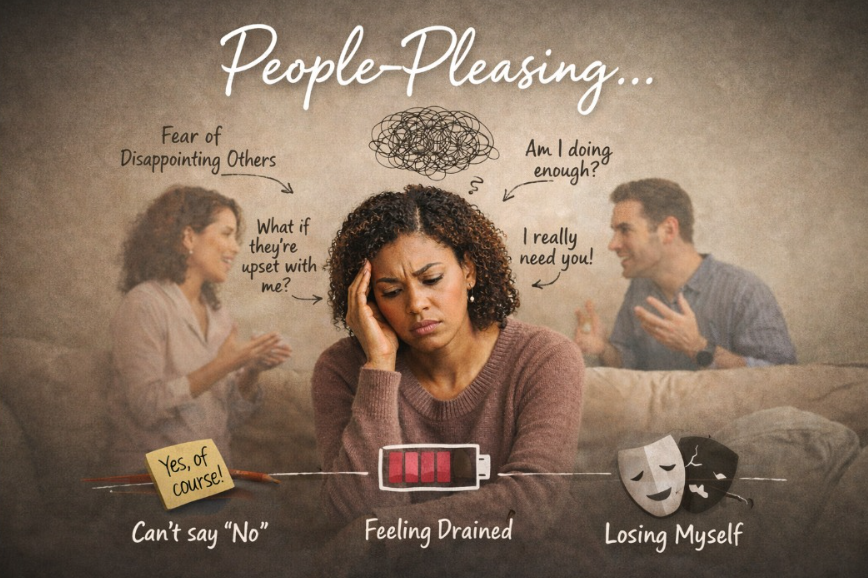
Learning to Choose Yourself Without Losing Your Heart There is a kind of strength that the world often praises—the person who always shows up, always says yes, always keeps the peace, and always puts others first. On the outside, that person is dependable, thoughtful, and selfless. But beneath that strength, there can be a quiet exhaustion that often goes unseen. What happens when the one who carries everyone else begins to feel heavy? What happens when the one who gives so much realizes there is very little being poured back into them? This is the quiet weight of people-pleasing. What Is People-Pleasing? People-pleasing is often misunderstood as simply being kind or considerate, but it runs much deeper than that. It is a pattern rooted in the desire to be accepted, approved of, and valued—sometimes at the expense of your own needs, voice, and emotional well-being. It sounds like telling yourself, “I don’t want to upset anyone,” or “It’s easier if I just go along with it,” or even, “What will they think of me if I say no?” At its core, people-pleasing is not about kindness alone, it is often connected to fear. Fear of rejection, fear of conflict, fear of disappointing others, and sometimes, fear of not being enough. For many individuals, this pattern begins long before adulthood. It often develops in environments where love or approval felt conditional, where being agreeable created safety, or where emotions were dismissed. Over time, these experiences can shape a belief system that quietly says, “My value comes from what I do for others, not who I am.” Without realizing it, this belief can follow someone into their relationships, work, and identity. Signs & Symptoms of People-Pleasing As people-pleasing becomes a pattern, it often shows up in ways that feel normal but can be emotionally draining. You may notice that saying no feels uncomfortable or even guilt - inducing, leading you to overcommit despite feeling overwhelmed. There may be a tendency to avoid conflict at all costs, seek reassurance from others, or feel responsible for managing other people’s emotions. At times, you might apologize even when it is not necessary, suppress your thoughts to keep the peace, or adjust who you are to meet expectations. Over time, these patterns can create a quiet disconnection from your own needs, leaving you unsure of what you truly want or feel. How People-Pleasing Impacts Your Life People-pleasing can gradually shape the way you experience your relationships, family roles, and even your professional life. Within families, you may become “the strong one” or “the one who holds everything together,” often placing your own needs aside. In relationships, this pattern can lead to imbalanced dynamics where you give more than you receive, and where unspoken resentment quietly builds over time. In work environments, people-pleasing may show up as difficulty advocating for yourself, taking on more responsibilities than you can manage, or feeling uncomfortable setting boundaries. Internally, it can begin to influence your self-perception, tying your worth to how much you do rather than who you are. You may find yourself questioning your identity and wondering, “Who am I beyond what I do for others?” The Mental Health Impact While people-pleasing may appear as strength on the outside, it often carries a significant emotional and mental load. Constantly prioritizing others can lead to burnout and emotional exhaustion, leaving you feeling drained and overwhelmed. Anxiety may develop around how others perceive you, and resentment can build when your own needs remain unmet. Over time, this pattern can contribute to feelings of sadness or depression, especially when you begin to feel unseen or disconnected from yourself. Many individuals find themselves wearing a “happy face” outwardly while struggling internally, carrying emotions that have not been fully expressed or acknowledged . Healing from People-Pleasing Healing from people-pleasing is not about becoming distant or uncaring, it is about learning that you can be both compassionate and have boundaries. It is about recognizing that your needs, voice, and well-being matter just as much as anyone else’s. This process begins with awareness. Taking time to notice when you are saying yes out of obligation rather than desire can be a powerful first step. It also involves gently exploring the fears that may arise when you consider choosing yourself. Healing is not about changing who you are. It is about returning to who you have always been, before you felt the need to earn your worth. Coping Skills & Strategies As you begin this journey, small, intentional steps can create meaningful change. Healing from people-pleasing is about learning to include yourself in the care you so freely give to others. ✓ Pause before you say yes Give yourself space to check in: “Do I truly have the capacity and desire for this?” ✓ Practice saying no without over-explaining A simple, respectful response is enough: “ I’m not able to commit to that right now. ” ✓ Check in with your needs daily Ask yourself: “What do I need today—mentally, emotionally, physically?” ✓ Challenge guilt when it shows up Guilt doesn’t always mean you’re doing something wrong—it may mean you’re doing something new and healthier. ✓ Set small, realistic boundaries Start in one area. Small, consistent boundaries create lasting change. Affirmation “I am worthy of love, respect, and care—even when I am not giving, fixing, or doing for others. I choose to honor my needs without guilt.” If you are in the Dallas/Plano area, LaTreece Ross Counseling Services offers both in-office and telehealth therapy sessions to support your healing journey. Sometimes the most life-changing decision we make is choosing to care for our own well-being. Your healing journey is worth the investment.

Finding Your Strengths, Personality, and Career Direction Without Losing Yourself

Full Title: Stuck on Scroll: How Social Media Hijacks Your Focus and How to Take It Back

When Self-Love Feels Unfamiliar: Learning to Pour Into Yourself..

Strong, Capable… and Quietly Exhausted: What Women Carry...